What TESTBOX simulates, and how we know it's right. Nothing here is animated or faked. It's real physics, tested against real fights.
Every bot is a set of rigid bodies built from its CAD: chassis, wheels on axles, and a weapon on its own bearing, each with real mass and inertia.
The world steps 2,500 times a second, so a weapon hit plays out over several steps instead of skipping through. It's built on MuJoCo, an open-source physics engine made for robotics research.
Spin up a weapon and you've built a gyroscope. Turn a drum or vertical spinner hard and it rolls onto one wheel. Knock a horizontal spinner off level and it fights back.
None of that is scripted. The weapon is its own spinning body with inertia measured from the CAD, so gyroscopic precession comes straight out of the equations of motion.
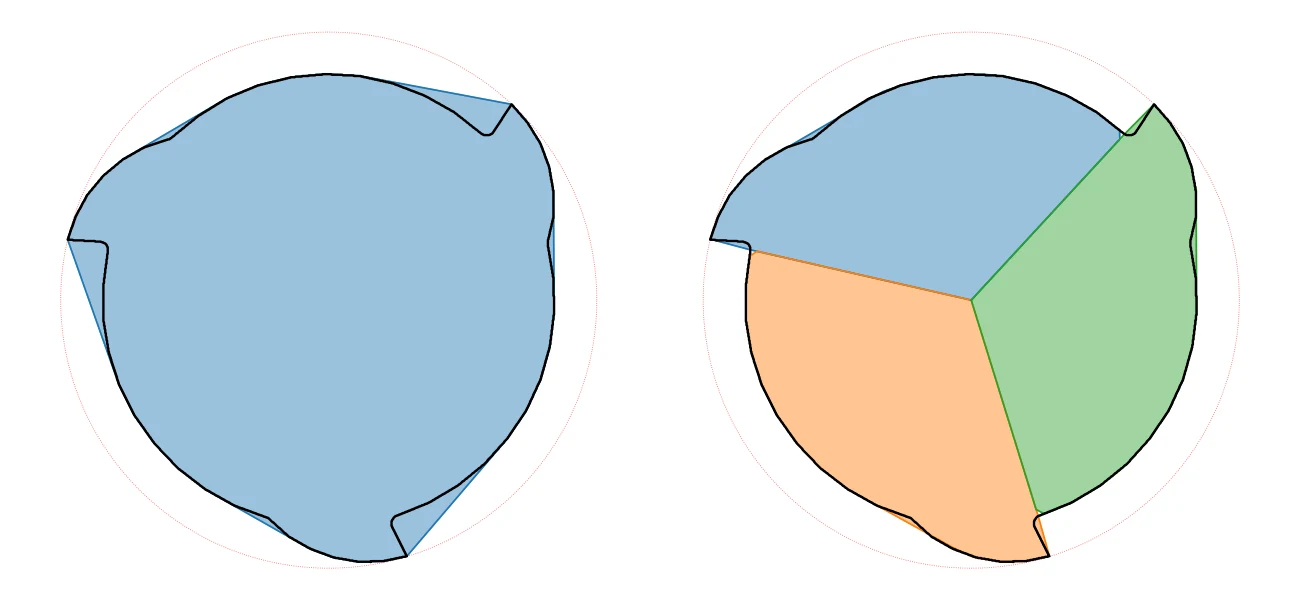
Bite comes from a tooth's rake angle. Physics engines collide convex shapes, and wrapping a toothed weapon in one convex shell fills the gap behind each tooth, which flattens the rake and kills the bite.
The importer splits the weapon at the root of every tooth, so each face keeps its real rake angle, and then checks the result against the CAD. On this three-tooth disc, one shell keeps 30% of the bite and the split version keeps all of it.
Wheels are driven by motor torque, tires flex and slip, and weight shifts as you turn and brake. Weapons lose speed to air drag fitted to their own shape.
The game runs exactly the same physics as our test tools, so what we measure is what you drive.
Damage is the energy your weapon actually puts into the other bot. Wall hits, floor hits and glancing blows don't count, but clean, solid hits do.
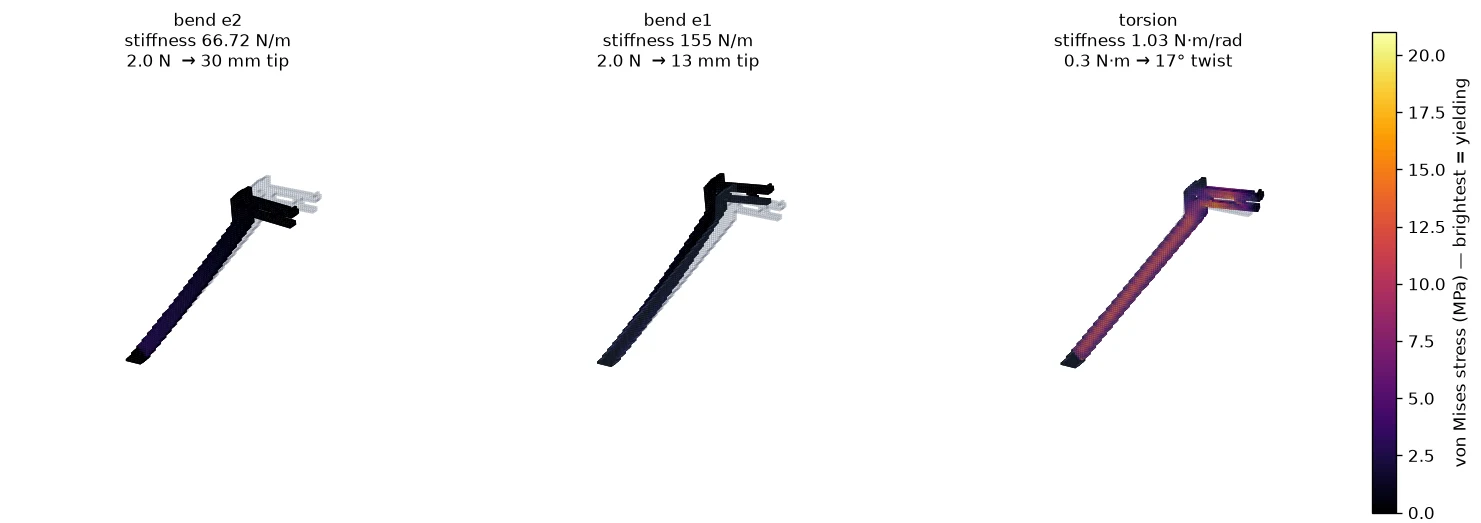
Next up: parts that bend and break. At import, each part gets a finite-element analysis from its real shape and material, which gives how stiff it is and how much load it can take before it yields.
A prototype already does this for single parts, like the UHMW leg below.
We built a computer-vision tracker that follows bots through overhead video of real fights. That gives real trajectories to hold the sim against: acceleration, turning, recovery, and what happens after a hit.
Every physics change is measured against those, and against controlled tests, before it ships.
Side-by-side comparisons with real fights will go here once we have permission to show the footage.
The same inputs give the same fight, bit for bit, on Mac and Windows. That's what keeps online play fair and replays exact, and it lets a disputed result be settled by re-running it.
Every match ends with both machines holding an identical fingerprint of the fight state. If they don't match, the match is flagged.
If something about how your bot behaves looks wrong, we want to hear about it.